
Georgia Aquarium
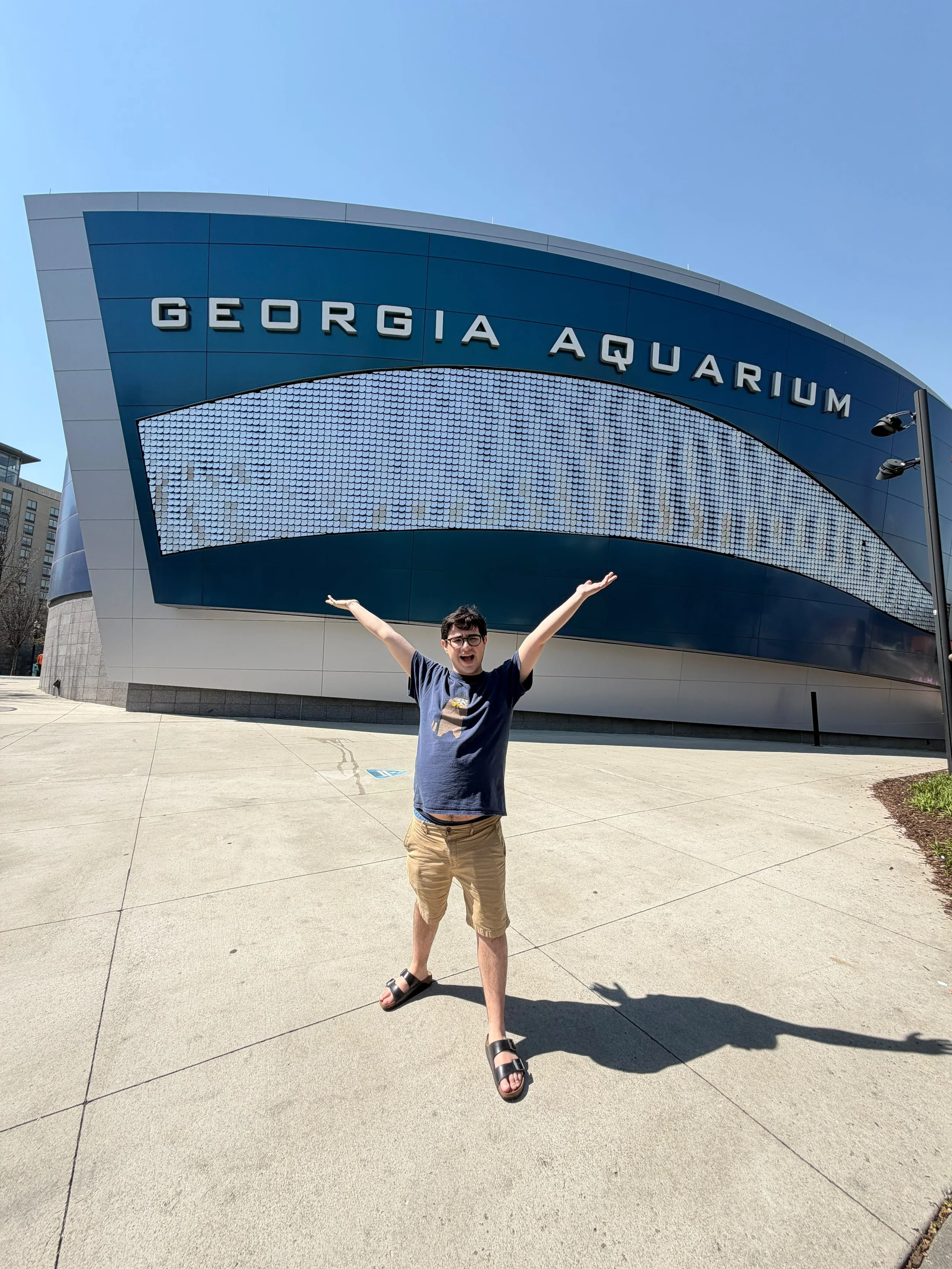
Hello, I’m Cory, and I’ve loved animals all my life. I read books about them, I watch shows about them, I draw them, but my favorite thing to do is go see them at zoos, aquariums, and other places that primarily display and care for them! So far, I’ve been to 76 different dedicated animal facilities, and this is the story of my trip to the 73rd one I’ve been to: the Georgia Aquarium!
But what was I in Georgia for? Well, last February, my mother and I reached out to the main spokesperson for the Association of Zoos and Aquariums (or AZA for short) to see if we could attend their annual mid-year conference in Atlanta. Miraculously, they said “yes”, and the trip was booked! I flew out to Atlanta, met up with my mother at the airport, and we stayed the night at a small hotel. The next day, we moved to the Hilton Suite where the meeting itself was being held. We could’ve just crashed at our room right then and there, but I wanted to experience the Georgia Aquarium properly before the big mixer the following night.
After Ubering to a much-needed brunch, we crossed the street, went around the back of the aquarium building, waited in line, and finally got to step inside the Georgia Aquarium! But before I can talk about any of the exhibits, I feel like the aquarium lobby deserves some attention. With all the ramps and escalators and little gift shops off to the side, most would compare it to a shopping mall or an airport terminal. But the combination of the big, empty space and various exhibit signs reminded me of a video game hubworld, like Gruntilda’s Lair in Banjo-Kazooie. But enough about the lobby, time for fish!
Naturally, the first stop on our journey was the Ocean Voyager, one of the most genuinely impressive exhibits I’ve ever seen in my life. Just to give you an idea of how dang BIG this thing is...
It's over 260 feet long...
Over 125 feet wide...
Over 30 feet deep...
Holds over 6 million gallons of saltwater...
And has over 185 tons of acrylic windows!
I can see why they needed Home Depot to build it! But a fish tank isn’t complete without fish (obviously), and out of the thousands of individual fish across 50 species, there was one I wanted to see in particular. After stepping into the 100-foot-long tunnel, I kept my eyes peeled for Yushan, the last of the Georgia Aquarium’s original quartet of Whale Sharks. However, despite being over 30 feet long, I couldn’t find him at first. Fortunately, there were still countless other fish to observe! There were Reef Sharks, Cownose Rays, Groupers, and Guitarfish, but there’s a couple I’d like to give special mention to. First was Ginzu, a Sawfish who I had previously seen before at the Shedd Aquarium in Chicago! She wasn’t the first or last Sawfish I’ve seen this year, but she was definitely the most special. There were also the Manta Rays, which I thought I had seen before in Cabo San Lucas, but it turns out those were actually Devil Rays, who are closely-related but way smaller. Tallulah, the largest of Georgia’s 3 Manta Rays, has an 18-foot wingspan, and likely weighs over 3,000 pounds! Those measurements put most giraffes to shame!
We spent 20 minutes in that tunnel, but there was no sign of Yushan. Then, as I was talking with one of the aquarium’s docents, I caught a brief glimpse of some white stripes and polka dots on the left side of the tunnel. I started stammering and sputtering like Courage the Cowardly Dog trying to warn Muriel about a monster. Moments later, I looked up to see a school bus-sized shark swimming right over my head! If not for the Humpback Whales I saw in Cabo, Yushan the Whale Shark would be the single-largest animal I’ve ever seen in my life!
I could’ve spent our entire visit ogling Yushan, but he was far from the only star attraction at the Georgia Aquarium! Our next stop was Cold Water Quest, a two-story exhibit home to creatures from temperate and sub-arctic waters. The stars of this zone were easily the Beluga Whales, who share their tank with a couple of Harbor Seals in what might be the only cetacean/pinniped mixed-species exhibit in the entire world! I’d love to talk more about how great the Belugas were right now, but my best experience with them actually happened the day after. More on that in a bit.
There were still plenty of other amazing animals in Cold Water Quest. We saw Japanese Spider Crabs, the largest living arthropod species, and their tankmate, a strange shark relative called a “Chimaera” or “Ratfish”. Their Giant Pacific Octopus was the most active one I’ve ever seen, and while I thought that the Weedy Sea Dragons were out of place, it turns out they live in much colder waters than I thought they did! A quick hike up a ramp brought us to the second floor of the exhibit, where we saw Sea Otters doing typical Sea Otter activities like floating on their backs and being adorable. Across from them was a seabird aviary, home to Murres, Guillemots, and two species of Puffin (Horned and Tufted). With their black and white plumage, a lot of guests mistook them for penguins, but honestly? I think they gave us a much better showing than the African Penguins, who were up to their usual pastime of standing around and doing nothing.
Once we were done in Cold Water Quest, we headed back downstairs and made our way over to Sharks! Predators of the Deep. Sharks! (yes, the exclamation point is in the exhibit name) is home to the bigger, more predatory shark species that wouldn’t play nice with the residents of Ocean Voyager, and all three of its main residents are species I had never seen before!
First were the Great Hammerhead Sharks, one of the most famous shark species in the world, but a rare sight in aquariums due to the fact that they specialize in hunting stingrays, a trait that got them kicked out of Ocean Voyager years ago. How do they hunt them? Well, all sharks have special pits on their faces (known as “Ampullae of Lorenzini”) that allow them to detect weak electrical signals in the water, such as the ones produced by muscles moving. The Hammerhead’s unique head shape provides room for even more of these pits, so their electroreception is even stronger than that of other sharks! Once they’ve detected a stingray buried in the sand, they use their wide head to pin it to the seafloor and finish it off!
Next were the Silvertip Sharks, who were the most “average” looking sharks in the exhibit, but what I didn’t know was that the Georgia Aquarium is the only facility in the United States of America to EVER keep them! But the most special shark in the whole tank is the Tiger Shark, the second-largest predatory shark after the Great White Shark, and the fourth largest shark overall! Like the Silvertips and Whale Shark, Georgia is the only aquarium in the continental United States to keep a Tiger Shark, so getting to see such a well-known but rarely-seen species with my own eyes was something special!
After we were done with Sharks!, we passed by the Sea Lions, and ventured into River Scout, which was under renovation during our visit. While this unfortunately meant no Alligators or Asian Small-Clawed Otters, there were still plenty of other animals worth mentioning! There were shoals of Piranhas, various turtles (including the hilariously-named River Cooter), a HUGE Freshwater Pufferfish, fearsome Tigerfish, and a black and red Fire Eel! But it was the Jacanas that interested me the most. Jacanas are wading birds, and are also known as “Lilytrotters” or “Jesus Birds” due to their ability to walk across the tops of lilypads without sinking. They can do this thanks to their long, slender toes that evenly spread out their weight, kind of like snowshoes! Here’s another foot-adjacent Jacana fact: male Jacanas are the ones that care for their young, and will sometimes carry their chicks under their wings with their legs dangling underneath!
A quick ride up the escalator brought us back up to the second floor, and right next to a tank of Electric Eels! I’d love to make an “Eels and Escalators” reference for all the SpongeBob fans reading this, but one: I already made that joke at the Mall of America SEA Life Aquarium, and two: Electric Eels aren’t eels at all! Anyways, the next exhibit on our list was Dolphin Coast, which was actually a fairly short visit. This was because the actual “exhibit” part of Dolphin coast is a singular window, while the main attraction is the stadium pool where they do the dolphin shows. The Sea Lions have a similar situation going on downstairs. I have nothing against marine mammal shows, but we just didn’t have the time nor the tickets to do either. So after a bit, we just moved through the empty Gator Crossing, caught a sneak peek at the exhibits that now hold a pair of Binturongs, and checked out...
...Aquanaut Adventure! This area is home to a lot of smaller animals that don’t really fit in with the rest of the aquarium, and many of them have quite remarkable abilities! The Wood Frog, for example, can survive the harsh winters of the Arctic Circle by freezing itself solid! The Tentacled Snake fakes out its prey by striking where it predicts they’ll swim rather than directly at them. But the Mantis Shrimp might be the most extraordinary animal in the whole building! They can punch as fast as a bullet, and the impact briefly heats the surrounding water to the same temperature as the surface of the SUN!
To end off our visit for that day, we went back to Ocean Voyager to see the Whale Shark and Manta Rays again. Sorry to all the Tropical Diver fans out there, I regret skipping that area, too. Anyways, we sat in front of the 23-foot tall, 61-foot wide, 2-foot thick viewing window as the tank’s residents swam by. I think my favorite moment from that day was watching the keepers feed Yushan the Whale Shark. There was a keeper in a dinghy at the top of the tank, and as they paddled around, they slowly dumped a bucket of plankton into the water for the Whale Shark to eat! I could even see the water funneling into his throat! Now you might be thinking that the keeper would be at risk of being eaten alive during this process, but you’d be wrong! While the Whale Shark’s mouth can be up to five feet wide, their throat is only about the size of a ping-pong ball! And that’s where this adventure would’ve ended...if not for the fact we went to the AZA mixer the following night!
There, we got to go behind the scenes at Ocean Voyager and Cold Water Quest, and this is when I can finally talk about how great the Belugas were! We got to watch a training demonstration at the surface of their tank, where the keepers encouraged the whales to do specific actions in exchange for a fish. Retrieving their toys, waving their flippers, slapping the surface of their pool with their tails, making all sorts of crazy noises, one of them even partially leapt into the air and spun around while spitting out water like a fountain! I knew Belugas were vocal creatures (they aren’t called “Canaries of the Sea” for nothing), but you can’t really notice that with a thick layer of acrylic between you and the whale.
At the top of Ocean Voyager, I got to see the previously-mentioned Whale Shark mouth/throat-size discrepancy in the form of a preserved set of Whale Shark jaws with a ping-pong ball in their center representing the throat. But what really impressed me was getting to see the Whale Shark and Manta Rays from above as opposed to below or from the side! They looked like an aircraft carrier and three stealth bombers, or a strip of night sky and three Bat-Signals!
The next day, we went to Zoo Atlanta...but that’s a story for another day! Before I end this blog/journal/whatever-you-want-to-call-it, I feel like I should mention where I’m heading to next! At the end of September, I will be at the Oregon Zoo (for the second time in my life) for the annual AZA conference! I’ll be sure to write about that once I return from it, so until then, this is Cory Gould, signing out!
